
Where AI fits in whistleblowing and incident management
Trust is the foundation of an effective whistleblowing program. Employees and other reporters need confidence that they can raise concerns without fear of retaliation and their reports will be heard, investigated and handled appropriately.
For risk and compliance teams, maintaining that trust requires more than simply providing a reporting channel. Teams must collect useful information, protect confidentiality, triage incoming reports, conduct investigations, communicate with reporters and understand what incident data says about organizational risk.
This is where AI can support your people throughout the reporting and investigation lifecycle.
Here are just a few examples: Conversational reporting can help reporters provide relevant information, while translation can support communication across languages. For investigators, AI can summarize case information and evidence, suggest classifications and surface potentially related cases. At the program level, conversational analytics can help compliance leaders explore incident and benchmark data using natural-language questions.
These capabilities should support human expertise rather than replace it. Investigators and compliance professionals must always remain responsible for reviewing AI-generated recommendations, applying their own judgment and making all decisions.
Where traditional whistleblowing programs create risks
Whistleblowing and case management programs involve sensitive information, complex workflows and decisions that can have significant consequences for reporters and organizations.
Several common challenges can make those programs harder to manage effectively.
Fear of retaliation
Fear of retaliation remains a significant barrier to speaking up. Reporters may worry about being identified, ridiculed, demoted, suspended or terminated after raising a concern.
Part of addressing this issue requires reporting processes that protect confidentiality and, where appropriate, support anonymous reporting.
The challenge is collecting enough information to investigate a concern without compromising the reporter’s choice to remain anonymous. Conversational AI reporting experiences can help guide reporters through relevant follow-up questions while maintaining their anonymity.
Limited access to reporting channels
Reporters will have different preferences for raising their concerns. Some may be more comfortable using a digital reporting experience, particularly when discussing sensitive issues. Others may want to speak directly with a trained communication specialist.
Language, location, job role and access to technology also influence how someone reports a concern.
Providing multiple reporting options – including web, mobile and hotline channels – gives reporters more ways to choose an experience appropriate to their circumstances. Translation capabilities help further reduce language barriers for global workforces, making strides toward overcoming a major operational hurdle.
Inconsistent reporter follow-up
A reporter’s experience does not end when the report is submitted.
Communication during an investigation helps reinforce confidence that the organization takes the concern seriously. On the flip side, slow, inconsistent or absent follow-up can have the opposite effect.
AI translations help investigators continue communicating with reporters across languages after intake. Investigators can review translated follow-up messages and respond in their preferred language while preserving access to the original communication. This helps reduce language barriers without removing the investigator from a sensitive conversation.
Reporting volume is putting more pressure on investigation teams
According to the NAVEX 2026 Whistleblowing & Incident Management benchmark data, increased reporting is straining investigation and case management resources.
- 1.65
Median Reports per 100 Employees
Nearly 5% above the 1.57 recorded in each of the previous two years
- 28 days
Median case closure time
Case Closure Time increased from 21 days in 2024 to 28 days in 2025 – a 33% increase
- 31%
Anonymous reporter follow-up
Follow-up engagement with anonymous reporters reached a five-year high in 2025
How AI can support report intake and triage
One of AI’s most practical roles in whistleblowing programs begins when a report enters the system.
Traditional intake processes can leave investigators with incomplete information or require substantial manual work to determine where a case belongs. AI is well-equipped to assist with several of these tasks while keeping investigators responsible for reviewing the information and determining what happens next.
AI conversational reporting
An AI conversational reporting experience can adapt questions based on the concern a reporter describes. Rather than relying entirely on a fixed sequence of questions, it can prompt for relevant information that may help investigators understand the allegation.
Reporters should still have access to human support when they request it or when circumstances call for additional care or judgment.
Suggested case classification
AI can review report information and suggest an appropriate issue type or risk category. This reduces repetitive classification work and promotes greater consistency across cases. Investigators review the suggested classification against the case information and determine whether to use it.
Case summarization
Lengthy case records take time to review thoroughly, particularly when investigators inherit a case, begin triage or need to brief another stakeholder.
AI-generated summaries can organize important case information into a more digestible view, giving investigators a faster starting point while preserving access to the underlying record for verification.
Lengthy case records take time to review thoroughly, particularly when investigators inherit a case, begin triage or need to brief another stakeholder.
AI-generated summaries can organize important case information into a more digestible view, giving investigators a faster starting point while preserving access to the underlying record for verification. Even more importantly, having AI designed with important compliance context can add more useful insights to case review. NAVEX One capabilities such as AI rewrite for case notes and AI-powered incident and attachment summarization help investigators quickly understand key information and create clearer documentation to better inform report analysis.
AI can help investigators see connections across cases
An individual report never tells compliance teams everything they need to know about your organization’s risk.
Patterns may emerge across multiple cases involving similar conduct, locations, departments or individuals. And finding those connections manually can require extensive searching and review.
AI can be used to surface potentially related cases, along with information about why a relationship was suggested. Investigators would then review the cases, evaluate the suggested connection and decide whether the relationship is meaningful.
This pattern connection helps teams recognize repeat behaviors or emerging patterns earlier. AI surfaces information for consideration, and investigators determine what that information means and whether it warrants action.
AI can support evidence review and investigation documentation
Investigations can include lengthy documents, images and other attachments that require careful review. When case volumes increase, determining which evidence needs immediate attention consumes valuable investigator time.
AI-generated attachment summaries can provide investigators with a concise starting point for reviewing evidence and help them prioritize where deeper examination is needed.
The underlying evidence remains the source of truth. Investigators should verify AI-generated summaries against the original material before drawing conclusions or taking action.
AI can also help improve the clarity and consistency of case notes and other written documentation. AI-assisted rewriting also helps improve spelling, grammar, sentence structure and professional tone while preserving the underlying facts.
Here, AI’s role is to improve how information is expressed, not change investigative facts or decisions.
Six AI-Powered Risk and Compliance Workflows You Can Use Today
As compliance demands continue to grow, teams need smarter ways to manage risk without sacrificing oversight. This playbook explores six real-world AI-powered workflows available within NAVEX One that …

AI can improve implicated-party screening
Identifying people named in a report is more difficult across global workforces. Differences in spelling, punctuation, name order, accents and character sets can complicate matching.
AI-enhanced screening can help identify potential implicated employees across these naming variations, giving investigators additional information to review when managing case access.
Human review remains essential. Investigators must determine whether a potential match is accurate before acting on it.
Translation can support reporter communication throughout an investigation
Language barriers do not end after a report is submitted. Reporters often provide additional information, answer questions or seek updates while an investigation is underway.
Translation capabilities help investigators understand follow-up messages and continue communicating in their preferred language. Depending on the configured workflow, investigators can review original and translated versions of communications and respond while maintaining access to the underlying message.
This gives investigators another way to communicate across languages while keeping people responsible for the substance, tone and judgment involved in sensitive conversations.
Turn incident data into more useful compliance intelligence
Whistleblowing programs generate a substantial amount of data. The harder task is determining what the data says about the organization.
Static reports can show case volumes, categories and outcomes. Compliance leaders seeking to influence their organization need to go further:
- How have the results changed over time?
- Where are patterns emerging?
- How does performance compare with prior periods or relevant benchmarks?
Conversational analytics allows compliance leaders to ask questions about incident and benchmark data in natural language. Rather than manually assembling every report, they can explore questions about report volume, substantiation rates and other program trends through a conversational experience.
AI-generated summaries and visualizations can make the resulting information easier to explore and communicate. Compliance professionals remain responsible for interpreting those results, applying organizational context and deciding what action to take.
Compliance teams are already putting AI to work
According to the NAVEX 2026 State of Risk & Compliance Report, AI is more widely used across compliance activities, including investigations, reporting and analytics than last year.
- 29%
Use AI for investigation support
Nearly three in 10 surveyed organizations already use AI to assist investigation work
- 32%
Use AI for program reporting and analytics
AI is helping teams analyze compliance information and explore program performance
- 78%
Compliance involvement in AI decision-making
Up from 65% in 2025

Keep human judgment at the center of AI-assisted investigations
The value of AI in whistleblowing and incident management depends on how it is governed.
Investigations often involve employment decisions, allegations of misconduct, confidential information and other matters with significant consequences. AI-generated classifications, summaries, matches and recommendations require appropriate human review.
A responsible approach makes clear where AI is being used, what role its output plays and who remains accountable for the decision.
For compliance teams, the principle is straightforward: use AI to surface information, reduce repetitive work and identify connections while keeping people responsible for interpretation, judgment and action.
When reporters trust the process and investigators have better access to relevant information, organizations are better positioned to identify concerns earlier, investigate consistently and turn what they learn into program improvements.

How NAVEX can help
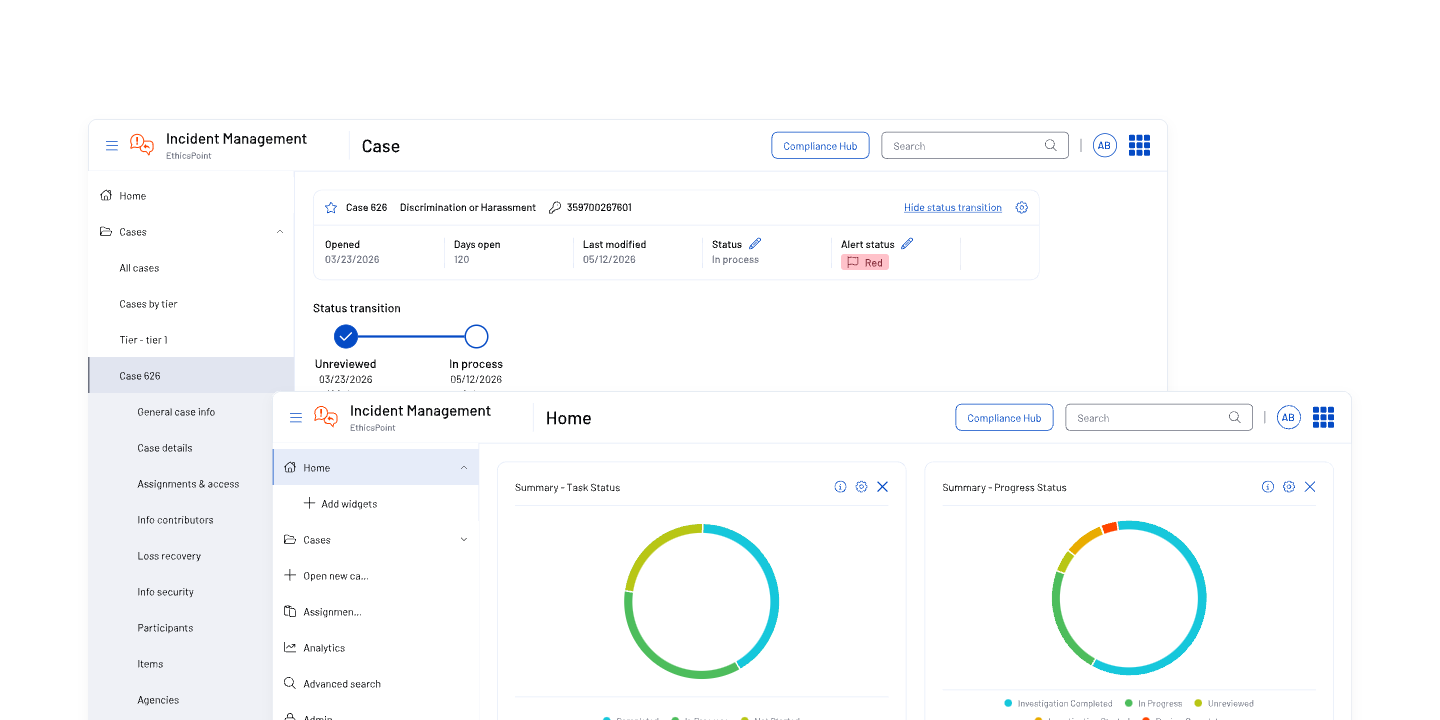
NAVEX One Whistleblowing & Incident Management brings reporting, case management, investigations and program data into a connected workflow.
AI capabilities can assist with tasks such as case summarization, classification, translation and investigative communication, reducing repetitive work while keeping investigators responsible for decisions. As those capabilities expand, AI can also help teams identify potentially related cases and explore incident data for patterns and trends that may otherwise be difficult to see.
At NAVEX, we approach AI with human oversight, transparency and governance at the center. The objective is to give compliance professionals better information at the point where their expertise is needed – without handing consequential decisions over to AI.
When combined with NAVEX One’s broader compliance ecosystem, Whistleblowing & Incident Management can also connect reporting insights to areas such as Ethics & Compliance Training. Those connections can help organizations turn what they learn through reports and investigations into targeted improvements across the compliance program.
Whistleblowing & Incident Management Software | EthicsPoint
NAVEX One EthicsPoint Professional is the industry’s leading AI-powered whistleblowing and incident management software for enterprise organizations.